
Dr Sally Bryant: a lifetime in the field
I grew up in the northern suburbs of Tassie. We didn't have a strong connection with nature but in my early twenties when I met my first husband, who came from a farm in the north-east, I think that fuelled a passion for being outdoors. We did a lot of camping, bushwalking and bird watching.
When I went to university, I enrolled in an Arts Degree but when I had some free spaces I picked up Zoology 1 and knew instantly - "this is what I have missed? I need to be working with animals, nature and conservation."

I loved everything about Zoology but the triggers were going out in the field and being close to animals... touching, trapping. I really wanted to learn and do more of that.
I had one lecturer in particular – Dr Eric Guiler - I loved his lectures. He talked a lot about saving charismatic species like gorillas and rhinos and conservation globally. He also lectured on the thylacine and devil, two species we knew very little about, and I really wanted to be working in that area. I went on to do a Science Degree then Honours on the potoroo and then a PhD on the eastern quoll, both of which were very field based and hands on. From then on, conservation was always going to be my career path.
I can remember the first time I went out trapping for potoroos and, like every ‘learner driver’ I really had no idea. I was guided by my lecturer, on putting traps out and then checking them in the morning. I remember the first time I trapped an eastern barred bandicoot, looking at it and thinking, what is that?

In those days you didn't have access to field guides, you weren't as connected as maybe students are these days. So, I can remember that first moment of seeing a creature in a trap and not knowing what it was.
Of course, there's a very steep learning curve when you're working with wildlife, and that excitement fostered what was to become my lifetime career of being in the field, learning and understanding how it all fits together. I started researching marsupials then switched to working in bird conservation.
It’s a career that has taken me all around the world, including to some of the most remote and exciting places. I’m learning every day and still feel like a beginner, but it is my destiny.
It is a real connection with nature. The physical connection is undeniably overwhelming. To touch, to feel the skin, the fur, to see the faces, to see the eyes, to hear the sounds. It is intoxicating. You cannot deny that those motivations will stay with you forever. You can never replace looking into the eyes of a little pademelon, holding a devil or hearing a forty-spotted pardalote. There's nothing that will ever replace those natural connections.

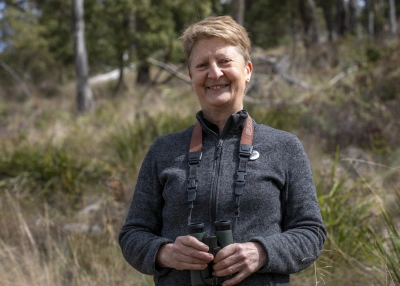
Dr Sally Bryant
I grew up in the northern suburbs of Tassie. We didn't have a strong connection with nature but in my early twenties when I met my first husband, who came from a farm in the north-east, I think that fuelled a passion for being outdoors. We did a lot of camping, bushwalking and bird watching.
When I went to university, I enrolled in an Arts Degree but when I had some free spaces I picked up Zoology 1 and knew instantly - "this is what I have missed? I need to be working with animals, nature and conservation."
I loved everything about Zoology but the triggers were going out in the field and being close to animals... touching, trapping. I really wanted to learn and do more of that.
I had one lecturer in particular – Dr Eric Guiler - I loved his lectures. He talked a lot about saving charismatic species like gorillas and rhinos and conservation globally. He also lectured on the thylacine and devil, two species we knew very little about, and I really wanted to be working in that area. I went on to do a Science Degree then Honours on the potoroo and then a PhD on the eastern quoll, both of which were very field based and hands on. From then on, conservation was always going to be my career path.
I can remember the first time I went out trapping for potoroos and, like every ‘learner driver’ I really had no idea. I was guided by my lecturer, on putting traps out and then checking them in the morning. I remember the first time I trapped an eastern barred bandicoot, looking at it and thinking, what is that?
In those days you didn't have access to field guides, you weren't as connected as maybe students are these days. So, I can remember that first moment of seeing a creature in a trap and not knowing what it was.
Of course, there's a very steep learning curve when you're working with wildlife, and that excitement fostered what was to become my lifetime career of being in the field, learning and understanding how it all fits together. I started researching marsupials then switched to working in bird conservation.
It’s a career that has taken me all around the world, including to some of the most remote and exciting places. I’m learning every day and still feel like a beginner, but it is my destiny.
It is a real connection with nature. The physical connection is undeniably overwhelming. To touch, to feel the skin, the fur, to see the faces, to see the eyes, to hear the sounds. It is intoxicating. You cannot deny that those motivations will stay with you forever. You can never replace looking into the eyes of a little pademelon, holding a devil or hearing a forty-spotted pardalote. There's nothing that will ever replace those natural connections.
You might like...

Natures Treasures
Coast to Cradle Wild Country vision survey opens to public

Christine Milne’s life for nature: Saving the Waldheim huts with Graham Richardson

Introducing Kuno - launch event
Newsletter
Sign up for stories about Nature and conservation from amazing people and groups from around the world. Brought to you by our social enterprise, Kuno.